


 infos-pistes
 meteo
meteo webcams
Key figures
- • Number of bends: 21
- • Start at Bourg d’Oisans: 717 m
- • Finish at Alpe d’Huez: 1860 m
- • Elevation gain: 1121 m
- • Length: 14.454 km
- • Average gradient: 7.9 %
- • Maximum gradient: 14 %
- • Climb record: Marco Pantani in 1997 in 37’35” (23.08 km/h)
The 21 bends
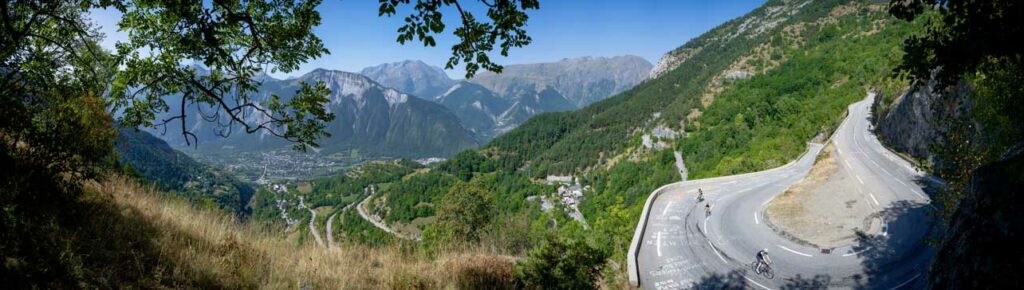
A legendary venue of the Tour de France, Alpe d’Huez and its 21 bends are an unmissable stage of the Grande Boucle. 21 signs mark the rider’s effort in a 14 km countdown over 1120 m of elevation gain. On average, nearly 400 cyclists climb the mythical ascent every day, more than 7000 cycle tourists take part in La Marmotte, and 2000 receive a certificate officializing their climbing time.
* Certificate issued for a fee of €1, donated to a charity
Alpe d’Huez is truly the Mecca of cycling, and above all the ride to do once in a lifetime!
The route
After warming up on the fine straight sections of the Oisans valley, you will arrive at the foot of the famous Alpe climb.
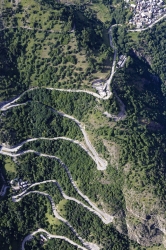
10 m after crossing the start line, you get straight down to business and… Farewell to the flatlands. Start at 737 m. The first very steep ramp takes you to bend 21 (altitude 806 m) and continues with a formidable climb up to bend 17 at 965 m. Once past this bend, you reach the village of La Garde, where the 200 m of gentler gradient offer a chance to recover. Here, the strong riders push on and pick up speed, while the less strong catch their breath before seeing bend 15 (1025 m) appear, where the gradient steepens again for over a kilometer. At bend 14, on your left, the monument dedicated to the memory of Joachim Agostino watches you pass in relatively good shape.
A slight flattening leads you to Ribot d’en Bas, and as you leave it you will appreciate the next hamlet, Ribot d’en Haut. At 1161 m, bend 12 welcomes you, and the sequence of bends 11/10/9 reveals everyone’s form, whatever their level. The last moment of relative ease is the arrival at Sainte-Ferréol (1390 m – Huez cemetery), where a water point allows struggling souls to recover. Then comes the climb and crossing of the village of Huez.
From bend 5 onward, you are back in the thick of it until the junction known as “Patte d’oie”, and there the last 3 bends follow one another on a gradient similar to the first part of the climb, up to La Garde.
Bend 1 (1713 m), very wide, concludes the climb towards the resort, then leads you into Vieil Alpe. Pass under the tunnel and, at the Chalet Le Camigane, the red flame of the last kilometer revives the climber’s final efforts up to the flatter summit section between the two roundabouts. Another 300 m and you will have completed the 21 bends, the most mythical in cycling.
In April and December
It is not uncommon, even in the middle of winter, in cold, dry weather, to be able to climb the slopes of Alpe d’Huez.
Timed start
The starting point is located opposite the EDF gate, 300 m after the junction when leaving the national road at the exit of Bourg d’Oisans.
Timed finish
Once you have passed the last roundabout, on your left, the 300 m of Avenue du Rif-Nel lie ahead. The finish line is at the top of the avenue.
Panorama
The Alpe climb is made with the Taillefer behind you. On your left, you will see Villars Reculas, and in the final bends you will face the Grandes Rousses massif. During the descent, you can enjoy views over the Oisans valley.
Alpe climb certificate
From May to September, Alpe d’Huez Tourisme issues more than 2000 “Alpe climb” certificates to cycle tourists tackling these 21 bends (on foot or by bike), officializing their climbing time. This certificate is given to athletes for a symbolic fee of €1, donated to a charity:

The amount raised from certificate sales will be donated to the Pédiatres du Monde Association

Join Alpe d’Huez on Strava: Alpe d’Huez Strava Cycling Club



 infos-pistes
 meteo
meteo webcams